If you’ve ever shopped for a boring and milling machine, you know it’s not like grabbing a toaster or a laptop—this stuff is big, expensive, and makes or breaks production for a lot of manufacturing shops. As a supplier, I hear the same question all the time from buyers: “Why is this one $20k and the exact same size one $80k? What’s the deal?” It’s not just random markup, either. Every little detail—from how the machine is built to who’s behind it—adds up to that final price tag. Let me break down the real factors that drive costs, straight from someone who’s spent years fixing, selling, and tweaking these machines. Boring And Milling Machine

First off, the core build quality—especially the materials and precision engineering—might be the biggest hidden cost no one talks about. Let’s start with the base of the machine: boring mills need to stay rock-solid, right? If the frame warps even a tiny bit when you’re cutting a 1,000-pound steel part, your hole alignment’s off, and you’re wasting time and materials. Cheaper machines use cast iron with lower carbon content, or even thick steel plate welded together on a basic jig. I’ve seen some budget models twist 0.002 inches under a heavy cut—enough to mess up a $500 batch of parts. Higher-end machines use precision-grade cast iron that’s been stress-relieved for weeks (not just a quick bake in an oven) and machined on 5-axis mills, so every linear guide and spindle hole lines up within 0.0005 inches. That extra time and quality control? It adds a few thousand bucks to the build, but it saves buyers from headaches later. I had a client last year who bought a cheap boring mill, then spent $12k in rework on parts and labor in the first six months alone—way more than the difference between a quality machine and the budget one.
Next up is the spindle and drive system. The spindle is the heart of a boring mill—it spins the cutting tool, so if it’s flimsy, you can’t run heavy cuts or keep tight tolerances. Budget spindles are usually single-phase, belt-driven, and max out at 3,000 RPM. They work for light jobs, but if you’re milling titanium or cast iron, they’ll burn out in a year. Higher-end spindles are 3-phase, motorized (no belts to slip or wear out), and go up to 10,000 RPM with variable speed control. Some even have built-in cooling systems to prevent heat expansion, which keeps cuts accurate during long runs. The drive motors for the axes (X, Y, Z) matter too. Cheap machines use stepper motors—they’re fine for simple moves, but they skip steps under heavy load, leading to misaligned holes. Good machines use servo motors, which are way more precise and can handle constant heavy use. I once quoted a client a machine with a stepper vs. servo drive: the servo added $5k, but he’s now running 24/7 for 18 months without a single alignment issue. That’s not a markup—that’s a reliability cost.
Then there’s the tech and automation features, which can swing the price way more than you’d think. A basic manual boring mill is cheap, but add even a little CNC control, and costs jump 30-40% easily. Entry-level CNC systems are stripped-down—they do basic X/Y/Z moves, but can’t store multiple programs, have slow processing speeds, and aren’t compatible with common CAM software (like SolidWorks or Mastercam). Mid-range and high-end CNCs (think FANUC, Siemens, or Haas) are full-featured: they run complex 3D milling programs, have touchscreen interfaces, auto-tool changers, and even error-correction software that adjusts for heat or wear mid-job. What buyers don’t always get is that that compatibility with CAM software isn’t just a “nice-to-have”—it cuts programming time by 70% for a shop doing custom or high-mix work. I’ve had shops tell me they’d rather pay extra for a good CNC than spend $100 an hour on a programmer to work around a basic system. Also, add-ons like a digital readout (DRO) instead of a manual scale, a coolant system that’s filtered and chilled, or a laser tool measurer? Each one adds a bit, but they pay for themselves over time.
Don’t sleep on the brand and after-sales support—this is where a lot of buyers cut corners and regret it. Generic no-name machines might be 20% cheaper, but where do you go when it breaks? A lot of those brands are based overseas, have no local service techs, and only stock cheap parts that don’t fit right. If your machine goes down on a Monday morning, you don’t want to wait 2 weeks for a technician to fly in from another country. Established brands (including the ones I work with) invest in local service teams, keep common parts in stock, and offer 24/7 support. The warranty is a big part of this too: a cheap machine might have a 90-day parts-only warranty, while a quality brand offers 2-3 years on the frame and 1 year on electrical parts. Last year, a client with a no-name machine had a spindle fail 3 months after buying it; the repair cost him $8k, and he had to close the shop for a week. If he’d gone with a reputable supplier, that repair would’ve been covered under warranty, and a local tech would’ve been there in 24 hours. I always tell buyers: the price tag isn’t the total cost—you’ve got to add maintenance, repairs, and downtime too.
Size and capacity is another obvious but often overlooked factor. Boring mills come in all sizes: from small tabletop models that fit in a 10×10 shop, to huge floor-type machines that can handle 20,000-pound parts. A tabletop unit for small aluminum parts will run $10k-$30k, while a floor mill for heavy steel work can be $100k+. But it’s not just about maximum weight—some machines are rated for precision (like 0.001 inch tolerance) at full capacity, while cheap big machines can only hit that tolerance when they’re running tiny light cuts. Also, travel distance (how far the spindle or table can move) matters: if you need to machine a 10-foot long gear, you need a machine with enough X-axis travel, which costs more than a 4-foot travel model. I see buyers try to buy a machine just under their current part size to save money, then a year later they outgrow it and have to buy a bigger one—wasting money on the small machine and the big one. It’s better to size up a little if you plan to expand, even if it means a higher upfront price.
There are also regulatory and custom modifications that can add to the cost. If you’re in the U.S., you need machines that meet OSHA standards for guardrails, emergency stops, and electrical safety. Overseas buyers might need machines with 220V power instead of 110V, or specific language on the control panel, or compliance with CE standards. Some shops want custom add-ons, like a high-pressure coolant system for deep hole drilling, or a rotary table for round parts, or even a dust collection system for metalworking. These modifications aren’t just tacked on—they take engineering time, parts, and testing, so each one adds to the final price. I once had a client who needed a boring mill for aerospace parts, so we added a precision probe for part inspection and a custom tool rack; those tweaks added $7k, but it meant his machine could do in-process inspection, cutting out a whole separate step in his shop.
Wait, let’s not forget about market demand and supply chain stuff. Over the last few years, raw materials (steel, cast iron) have gone up 25-30%, and shipping costs for large equipment have doubled. That’s why prices didn’t drop after 2020 like a lot of people expected. If a machine is in high demand—right now, CNC boring mills for automotive and heavy equipment are super popular—suppliers can’t slash prices as much, because lead times are longer and parts are harder to get. Also, some small suppliers don’t have the volume to negotiate lower prices for parts, so their machines are more expensive than big brands that buy in bulk. I know a lot of buyers only look at the base price, but when supply chains are tight, a reputable supplier who can get you a machine in 4 weeks is way better than a cheap one that’ll take 12 weeks and delay your projects.
Now, I get it—for a lot of shops, budget is tight, and you can’t just drop $100k on a machine. But skipping on the factors I mentioned usually ends up costing more in the long run. I’ve talked to hundreds of shop owners who tried to save 10-15% upfront, only to have to repair, replace, or deal with downtime that ate way more profit. At the end of the day, a boring mill isn’t a disposable tool—it’s an asset that’ll last 10-20 years if you buy right.
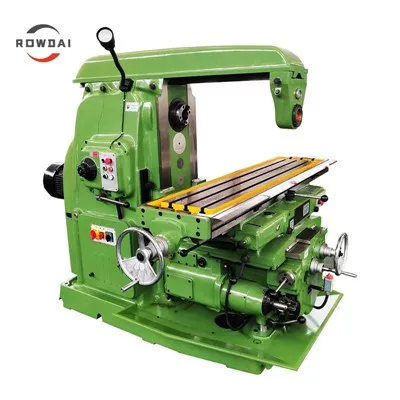
If you’re in the market for a boring and milling machine, whether it’s your first one or an upgrade, feel free to reach out to me to chat through what you need. I can walk you through sizing, options, and what makes sense for your shop, no pressure. Don’t hesitate to connect if you want to go over specs or get a customized quote.
Precision Grinding Machine References:
- Davis, J.R. (2010). Principles of Modern Machine Tools. Industrial Press Inc.
- Manufacturing Engineering Association. (2022). Cost Analysis of Metalworking Equipment: Total Cost of Ownership for Machine Tools. SME.
- International Organization for Standardization. (2019). ISO 12100: Safety of Machine Tools – Boring and Milling Machines. ISO.
- Smith, G.T. (2015). CNC Programming: Principles and Applications. Delmar Cengage Learning.
- Metalworking News. (2023). Supply Chain Trends in Heavy Machine Tool Manufacturing. Gardner Business Media.
Henan Rowdai Machinery Equipment Co., Ltd.
As one of the most professional boring and milling machine manufacturers in China, we’re featured by quality products and good price. Please rest assured to buy high-grade boring and milling machine for sale here from our factory. If you have any enquiry about cooperation, please feel free to email us.
Address: Building 9, E-Commerce Industrial Park, High-Tech Zone, Zhengzhou, Henan, China
E-mail: rowdai@rowdai.com
WebSite: https://www.rowdai.com/
