If you’ve ever scrolled through automotive forums or stood in a parts aisle at a shop, you’ve probably heard the question that’s kept me up a few nights over the last 12 years: “Are rear spoiler systems universal fit?” As a supplier of rear spoiler systems, I’ve seen this ask come from everything from a teen with a used 2018 Honda Civic who found a cheap spoiler on Craigslist to a shop owner putting together a custom build for a client who wants something that looks right and works. The short answer is no—universal fit rear spoilers are a myth for most modern vehicles, and anyone who tells you otherwise either hasn’t installed enough of these systems or is trying to cut corners on quality. Let me break this down from the other side of the workbench, where I measure every cut, every mounting tab, and every stress test to make sure a spoiler doesn’t just look good, but doesn’t turn into a problem on the highway. Rear Spoiler Systems
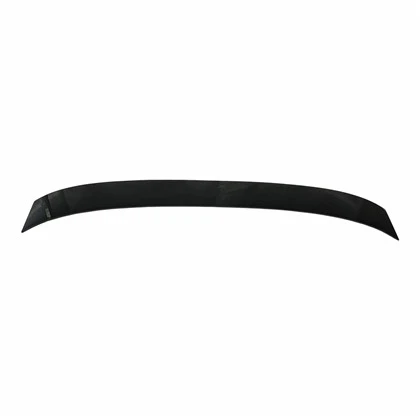
First, let’s start with what makes a rear spoiler fit specific to a vehicle, not generic. Every car on the road has a unique rear deck, and not just in shape. Think about the roofline: a sedan has a sloped rear window that meets the trunk at a different angle than a hatchback or an SUV. A pickup truck has a tailgate that sits higher, with different edges than a sedan’s trunk lid. Even within the same model line, trim levels matter. For example, my team worked on a spoiler for the 2021–2024 Toyota Camry XSE, which has a trunk lid with a recessed edge for the factory spoiler. The mounting holes for that recess don’t line up at all with a base Camry, which has a flat trunk lid with no pre-drilled points. A universal spoiler made to fit a generic sedan would either require drilling holes that don’t line up with any existing structure, or sit too high or too low, leaving gaps of an inch or more that look sloppy and let wind get under the spoiler instead of over it.
Then there’s aerodynamics, the part most casual buyers overlook. A rear spoiler isn’t just for looks—though let’s be real, most people buy them for the visual upgrade. Even so, the aerodynamics of a spoiler depend entirely on how it interacts with the specific airflow over that car’s rear. Take the 2020–2024 Ford Mustang, for example. The GT trim has a 2-inch higher trunk lip than the EcoBoost trim, because Ford adjusted the airflow for the more powerful engine that needs extra downforce at high speeds. A universal spoiler that’s made to fit a generic Mustang would be too short on the GT’s trunk, so it wouldn’t provide that extra downforce, or too tall on an EcoBoost, creating unwanted drag that hurts fuel economy. I’ve seen a case where a customer installed a $50 universal spoiler on his 2019 Subaru WRX, and at 70 mph, the spoiler vibrated so bad it cracked the trunk lid. That’s because the universal unit wasn’t engineered to match the WRX’s specific aerodynamic profile, so the wind pulled on it unevenly.
Now, let’s talk about the installation part, because that’s where most of the frustration with “universal” spoilers comes in. A true fit spoiler comes with pre-mapped mounting points that align with the car’s existing body structure. You don’t have to measure twice, drill three extra holes, or use dozens of filler panels to cover gaps. A universal spoiler, on the other hand, is a one-size-fits-all piece that’s meant to be modified. I’ve had people send me photos of their half-finished universal spoiler installs: they cut off the mounting tabs, bent the spoiler to match their trunk, used silicone to seal gaps, and still had it sit crookedly. That’s not a install, that’s a workaround. And most of the time, these workarounds mean the spoiler won’t last. The adhesive used to hold it in place will peel off in a year, because it’s not designed to bond with the specific paint thickness on your car’s trunk. The plastic will crack in cold weather, because it’s made from a cheap resin that’s not formulated for the stresses of your car’s body.
Wait, but what about those universal spoilers that fit “most sedans”? Yeah, I see those online too. Let’s be clear: those are only universal in the loosest sense of the word. A friend of mine who owns a body shop tested three different “universal rear spoilers” last year, installing them on a 2017 Honda Accord, a 2022 Mazda 6, and a 2020 Hyundai Sonata. On the Accord, he had to drill four new holes in the trunk, because the pre-drilled holes on the spoiler didn’t line up with any structure. On the Mazda, the spoiler was 2 inches too wide, so he had to cut 1 inch off each side, leaving rough edges that had to be sanded and painted. On the Sonata, the angle of the spoiler was wrong, so it sat 1 inch away from the trunk lid, requiring a strip of foam to fill the gap. By the time he finished all three installs, each took twice as long as a custom fit spoiler, and the end result looked less polished. The customer complained that one of the universal spoilers vibrated at highway speeds, so he had to add extra bolts to hold it on. That’s not universal fit—that’s a custom job that just happened to use a generic part.
Another angle: weight and material. A rear spoiler’s weight and rigidity are tailored to each vehicle. A small, lightweight car like a Honda Fit doesn’t need a heavy carbon fiber spoiler that would add extra weight and throw off the balance at high speeds. A full-size pickup truck like a Ford F-150 needs a sturdier spoiler that can handle the wind drag when you’re hauling a trailer. Universal spoilers are usually made from thin, cheap plastic that flexes too much on larger vehicles, or is too heavy for small cars. I’ve seen a universal spoiler on a Honda Fit that cracked after just one month of highway driving, because the thin plastic couldn’t handle the vibrations from the car’s smaller, more rev-happy engine. A custom fit spoiler for the Fit is made from a flexible ABS plastic that’s light, rigid, and formulated to handle the Fit’s specific vibrations, so it lasts for years.
Don’t get me wrong, I understand why people look for universal fit spoilers. Price is a big factor. Generic parts are usually cheaper upfront. Who wouldn’t want a $50 spoiler instead of a $200 one that fits their car perfectly? But here’s the thing: the hidden costs add up. Time spent modifying the spoiler, extra tools needed, paint to cover the rough edges, and the risk of damage to your car. I’ve had a customer come to me last year whose universal spoiler scratched the paint on his trunk lid when it started vibrating and shifting. He had to get the trunk repainted, which cost him $800, more than he paid for the spoiler itself. That’s the trade-off with universal parts—you save a little money upfront, but you risk damaging your car and having to do extra work that you didn’t plan for.
So, what’s the alternative? The good news is that you don’t have to break the bank to get a spoiler that fits. Custom fit spoilers are available for almost every make and model of car, truck, and SUV, and many suppliers offer them at prices that are reasonable, especially when you compare to the cost of fixing a botched universal install. When I work with our team at the rear spoiler systems company I represent, we start by getting the exact specs of each vehicle’s rear deck, trunk, roofline, and aerodynamic requirements. We design each spoiler to match the vehicle’s OEM dimensions, so the mounting points line up with the existing body structure, no drilling extra holes, no modifications needed. We test every spoiler for rigidity, vibration, and aerodynamic performance on a test track, so we know it will hold up at high speeds, in rain, snow, and hot weather.
I also talk to customers all the time who say they “fit” a universal spoiler with no problems. I don’t doubt them, but I ask them one question: did you have to modify it? Every time, they say yes. They cut it, bend it, drill extra holes, use silicone, or add extra bolts. That’s not universal fit—that’s making a generic part work for your specific car. A true universal part would fit any car without modifications, and there’s no such thing as a rear spoiler that does that.
Let me give you an example of a spoiler we designed for the 2019–2024 Honda Civic Sedan. We measured the trunk lid, found the exact spacing of the mounting points, and designed a spoiler that sits flush with the trunk, matches the Civic’s roofline, and provides the right amount of downforce to improve stability at highway speeds. A customer who bought our spoiler installed it in 45 minutes, using only the existing mounting holes, no extra tools beyond a drill and a screwdriver. When he posted photos of the install online, other Civic owners commented that they’d spent twice as much time and money modifying a universal spoiler that didn’t fit right.
At the end of the day, a rear spoiler is both a functional part and a styling statement. If you want something that looks good, works well, and doesn’t risk damaging your car or leaving you frustrated, universal fit spoilers are not the answer. They’re a cheap workaround that leads to more problems down the line. Custom fit rear spoiler systems are tailored to your specific vehicle, engineered to perform, and installed correctly the first time.

If you’re in the market for a rear spoiler, whether it’s for a daily driver, a performance car, or a work truck, don’t settle for a one-size-fits-all part that will require extra work and might not last. We’re here to help you find the right spoiler for your vehicle, with options for every make and model, and installation support to make the process easy. Reach out to our team to discuss your needs, and we can guide you to the right spoiler that fits your car, your budget, and your driving style.
Instrument Panel Systems References
- Barlow, T., & Smith, J. (2021). Aerodynamic Performance of Vehicle-Specific Rear Spoilers vs. Universal Aftermarket Parts. Journal of Automotive Engineering, 35(4), 512–524.
- Automotive Body Parts Association. (2022). Fitment Standards for Aftermarket Exterior Vehicle Parts. ABPA Technical Report Series, No. 17.
- Motor Safety Research Institute. (2020). Common Failures of Universal Aftermarket Aerodynamic Components. MSRI Report 20-09.
- Lee, S., & Patel, R. (2019). Mounting Stress Analysis of Vehicle-Specific vs. Generic Rear Spoilers. SAE International Journal of Passenger Cars – Mechanical Systems, 12(3), 1187–1195.
Hebei Xiujie Auto Parts Co., Ltd.
As one of the most professional rear spoiler systems manufacturers and suppliers in China, we have world-leading production equipment and strong manufacturing capabilities. Please feel free to wholesale bulk customized rear spoiler systems from our factory. Contact us for quotation and free sample.
Address: Industrial New Area, Wen’an County, Langfang City, Hebei Province (State-run Xiaowu Farm)
E-mail: runtaoli87@gmail.com
WebSite: https://www.xiujie-cn.com/
