Hey there! I’m a supplier of integrated solar street lights, and one question I get asked a lot is, "What is the installation space required for an integrated solar street light?" Well, let’s dive right into it. Integrated Solar Street Light

First off, you gotta understand that the installation space isn’t just a one – size – fits – all deal. It depends on a few key factors.
The Size of the Light Itself
Integrated solar street lights come in all shapes and sizes. Some of the smaller ones are more compact and can be a great option for narrow pathways or backyard areas. These might have a light fixture that’s only around a foot or so in length and width. So, the actual space they take up on the pole or the base is relatively small.
On the other hand, the larger and more powerful integrated solar street lights are often used for bigger areas like parking lots or main roads. These can have much larger solar panels and light fixtures. The solar panels on these bad boys can be two to three feet long and a couple of feet wide. And the light fixture might be a foot and a half to two feet in diameter. You need to make sure there’s enough room on the mounting pole to accommodate these larger components.
The Height of the Pole
The height of the pole plays a huge role in determining the overall installation space. For sidewalks or small alleys, a shorter pole around 6 to 8 feet might be sufficient. These shorter poles don’t need a massive base, and the space they take up on the ground is relatively small. You can usually get away with a base that’s around 1 to 1.5 feet in diameter.
But for larger areas like sports fields or large parking lots, you’ll probably need a taller pole, say 12 to 18 feet. Taller poles need a more substantial base to keep them stable. The base for these taller poles can be 2 to 3 feet in diameter. You’ve also got to consider the vertical space. There shouldn’t be any low – hanging branches or obstacles above the pole that could interfere with the solar panels or the light.
Spacing Between Lights
Another important aspect is the spacing between multiple integrated solar street lights. If you’re lighting up a long pathway, you don’t want the lights to be too far apart, or you’ll end up with dark spots. But if they’re too close together, you’re just wasting money and energy.
For a regular sidewalk, a spacing of about 10 to 15 feet between lights is usually good. This gives you enough illumination without over – lighting. In a parking lot, you might want to space the lights 20 to 30 feet apart, depending on how bright the lights are and how large the lot is.
Let’s say you’ve got a small community park with a walking path. If you use our standard – sized integrated solar street lights on 8 – foot poles, you’ll need to figure out the ideal spacing for the specific area. Measure the length of the path, and then you can calculate approximately how many lights you’ll need based on that 10 – 15 – foot spacing rule.
Clearance Around the Light
You also need to consider the clearance around the integrated solar street light. The solar panels need direct sunlight to work efficiently, so there shouldn’t be any objects blocking the sun. This means no tall bushes or walls too close to the light.
I’d recommend having at least three feet of clearance around the light to ensure proper sunlight exposure. This also gives you enough space for maintenance. If something goes wrong with the light, you’ll need to be able to access it easily.
Land Conditions
The condition of the land where you’re installing the integrated solar street light matters too. If the ground is soft or uneven, you’ll need a larger and more robust base to keep the light stable. For example, in sandy areas, you might need to dig a deeper and wider hole for the pole base.
In rocky terrain, you could face challenges in digging the hole for the base. You might need to use special equipment to break through the rocks. And you need to make sure that the base is properly secured so that the light doesn’t wobble or fall over in windy conditions.
Let’s talk about an example. Suppose you’re looking to install integrated solar street lights in a rural area with a dirt road. The land there is relatively soft, so you’ll need to plan for a larger base for each light. You can’t just plop the light in a small hole; it won’t stay upright. A base that’s at least two feet in diameter and 2 to 3 feet deep will help to ensure stability.
Other Considerations
If there are any utility lines in the area, you’ve got to be extra careful. Make sure the installation of the integrated solar street lights doesn’t interfere with power lines, phone lines, or water pipes. You might need to check with the local utility companies before starting the installation.
Also, if the area is prone to high winds or storms, you’ll want to take that into account. You may need to install additional bracing or choose a more sturdy light design to withstand the harsh weather conditions.
So, as you can see, determining the installation space for an integrated solar street light isn’t just about a simple measurement. It’s a combination of factors like the size of the light, pole height, spacing between lights, clearance, land conditions, and other potential hazards in the area.
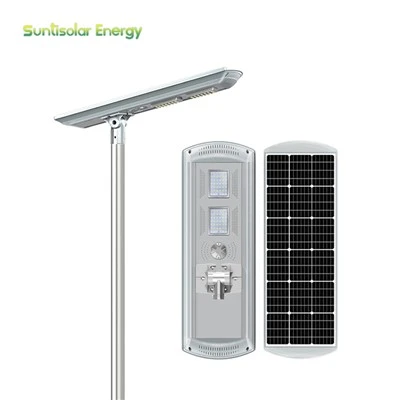
If you’re thinking about installing integrated solar street lights for your project, whether it’s a small backyard renovation or a large commercial development, I’m here to help. I’ve got a wide range of integrated solar street lights that can suit different installation spaces and lighting needs. Just reach out to me, and we can have a chat about your project requirements. We can figure out the best lights for your space and make sure you get the most out of your investment.
Solar Street Light References:
- "Solar Lighting Handbook" – A comprehensive guide on solar lighting systems and installation requirements.
- Industry experience and customer feedback from years of supplying integrated solar street lights.
Yantai Xutai New Energy Technology Co., Ltd.
Yantai Xutai New Energy Technology Co., Ltd. is one of the most professional urban road integrated solar street light manufacturers and suppliers in China. With a professional production team, we are able to meet the needs of the majority of our customers. Please rest assured to buy premium urban road integrated solar street light made in China here from our factory.
Address: No.229, Tongshinan Road, Zhifu District, Yantai City, Shandong Province, China
E-mail: Joe.chu@suntisolar.com
WebSite: https://www.suntisolar.com/
