If you’ve ever been stuck waiting weeks for a single aerospace part or a mold and die component to come off a mill, you know exactly why high-speed horizontal machining centers (HMCs) are the unsung heroes of modern manufacturing. As someone who’s been selling these machines for over a decade—talking shop with job shop owners, production line managers, and custom part fabricators every single day—let me break down what actually makes a high-speed horizontal HMC worth investing in, not just the marketing fluff manufacturers throw around. Horizontal Machining Center

First, let’s get one thing straight: “high-speed” isn’t just about how fast the spindle spins. I’ve seen cheap HMCs with 15,000 RPM spindles that rattle so bad at top speed you can’t hold a coffee cup on the machine table. Real high-speed capability is the whole system working in sync, and the horizontal orientation is the secret sauce that makes it better than vertical mills for most high-volume, tight-tolerance jobs.
Let’s start with the spindle. This is the heart of any machining center, and high-speed HMCs don’t mess around here. You’ll find spindles ranging from 12,000 RPM up to 30,000 RPM, some even higher for specialty jobs like microscopic medical parts. But it’s not just the RPM—look at how the spindle is powered. Most premium high-speed HMCs use direct-drive spindles, not belt-driven ones. Belt-driven spindles have that annoying wobble at high speeds and wear out fast under heavy cuts. Direct-drive spindles connect the motor straight to the spindle shaft, so there’s zero lost motion, less vibration, and they can hold that fast, consistent speed even when you’re pushing the tool through thick aluminum or tough titanium. And they’re cooled—critical stuff, because a hot spindle expands and throws off your tolerances. I tell customers all the time: if your spindle doesn’t have proper coolant, you’re wasting your money on a high-speed HMC. You’ll get a nice part today, but next month when the spindle heats up during an 8-hour run, you’ll be throwing out $500 worth of parts.
Next, the horizontal axis configuration. This is what sets HMCs apart from vertical machining centers (VMCs), and why high-speed versions shine for high-volume work. On a vertical mill, the spindle points straight down, so chips fall right onto the part you’re machining, covering it and the work area. That means you have to stop more often to clear chips, which kills speed and can damage expensive tools. On an HMC, the spindle is horizontal, so chips fly away from the cutting zone. No more stopping every 10 minutes to blow chips off the part. That’s a huge time saver—we’re talking 15-20% faster cycle times right there, even with the same spindle speed. But it gets better: most high-speed HMCs come with a built-in pallet changer. You can load a new part on one pallet while the machine is already running another part on the other pallet. So instead of waiting 5 minutes to swap parts, the machine does it automatically in like 30 seconds. I had a customer last year who switched from a vertical mill to our high-speed HMC, and he went from running 2 parts an hour to 8 parts an hour with the same number of operators. That’s the kind of ROI that makes owners do backflips.
Then there’s the rigid frame and linear guides. A lot of people think fast machines have to be flimsy to move quick, but that’s the opposite for high-speed HMCs. They’re built like tanks, but with precision engineering to keep that rigidity without extra weight. The frame is usually made of Meehanite cast iron, which dampens vibration way better than steel or aluminum. When you’re moving at high feed rates—some HMCs can hit 2,000 IPM (inches per minute) on the linear axes—any flex in the frame will show up as a bad part. Linear guides instead of traditional ball screws are another must-have here. Ball screws can expand and flex at high speeds, especially over long runs. Linear guides use recirculating bearings that glide along a rail, so they can move super fast, hold tight tolerances, and last way longer than ball screws under continuous high-speed use. I see so many cut-rate HMCs still using ball screws, and they’re a nightmare for maintenance. Customers call me within a year saying they’re replacing the ball screws because they’re worn out from all the fast movements. High-speed HMCs skip that headache.
Tool changers are another big one, especially for jobs that use multiple tools. A lot of high-speed HMCs have automatic tool changers (ATCs) that hold 40, 60, even 100 tools. The trick here is how fast the ATC is. Some cheap machines take 10 seconds to swap a tool—when you’re running a job that requires 20 tools, that’s 200 seconds of wasted time per part. Our high-speed HMCs have chip-to-chip tool change times under 2 seconds. That might not sound like a big deal, but when you’re running 1,000 parts, that’s over 1,500 minutes saved—25 whole hours, just from fast tool swaps. Also, look at the tool holder type. CAT or BT holders are fine for old mills, but high-speed HMCs use HSK or Capto holders. These are smaller, lighter, and they grip the tool at both the taper and the face, so they don’t slip at high RPM. I’ve had customers bring me parts from machines with CAT holders that have a weird taper because the tool slipped at 18,000 RPM. Never again, once they switch to HSK holders on our HMCs.
Wait, let’s talk about thermal stability again, because it’s a point most sales guys gloss over. High-speed HMCs generate a lot of heat—from the spindle, the motors, the linear axes. If all that heat isn’t managed, the machine will expand, and your part dimensions will be off. Top-tier high-speed HMCs have thermal compensation systems built in. These sensors track the temperature of every critical part of the machine, and adjust the tool path in real time to account for expansion. I had a customer who runs 24/7 medical part production—their parts need to be accurate to .0005 inches, no exceptions. When they upgraded to our HMC, they cut their scrap rate from 8% to less than 1%. The thermal compensation did that. No more waiting for the machine to “warm up” before running good parts, either. That’s another time saver.
Of course, none of this matters if the control is garbage. A high-speed HMC is only as good as its CNC system. You want a control that can handle high feed rates, look ahead at the tool path, and adjust speeds as you go. Old controls can’t process the line of code fast enough, so they slow the machine down to avoid errors. Modern controls like Siemens Sinumerik or Fanuc 30i are standard on quality high-speed HMCs. They have look-ahead features that scan 500+ blocks of code ahead, so the machine knows when it’s approaching a tight corner, a deep cut, or a thin part, and adjusts the speed and feed rate smoothly. No more jerking movements that break tools or throw off tolerances. I tell customers: if the control is a cheap off-brand, even a great spindle and frame won’t make your HMC worth it.
Now, let’s be real—high-speed HMCs aren’t just for big factories. I’ve sold our smaller high-speed HMCs to job shops with 2 operators, running custom parts for local businesses. One customer has a shop that makes custom aluminum enclosures for electronics, and he was running 10 enclosures a day on a vertical mill. With our high-speed HMC, he’s running 30 a day, and the tolerances are tight enough that his customers don’t have to do any secondary machining. The biggest knock I hear about HMCs is that they’re more expensive up front. But when you calculate cycle time savings, lower scrap rates, less downtime, and faster turnaround for customers, the ROI is usually 18 months or less. I’ve had customers come back after 2 years and say the HMC paid for itself twice over, from the time they saved on not having to hire another mill operator.
Wait, also, let’s cover the myths. A lot of people think high-speed HMCs are only for aluminum or soft metals. No, they’re great for hard metals too. We’ve sold several to aerospace shops that machine titanium parts. The high spindle RPM and rigid frame let them get a smooth surface finish on titanium that would take a 5-axis mill twice as long, and with less tool wear. Another myth is that they’re harder to maintain. Sure, you can’t run a high-speed HMC on a shoestring maintenance budget, but compared to old, worn-out VMCs that break down every week, the maintenance on a quality HMC is way easier. We provide quarterly check-ups, and our machines have way fewer moving parts that can fail than older mills.
So what should you actually look for when shopping for a high-speed horizontal machining center? Don’t fall for the “100,000 RPM spindle” marketing garbage—those are for specialty lab jobs, not production machining. Look for a direct-drive spindle with built-in cooling, HSK tool holders, linear guideways for all axes, a fast automatic pallet changer, thermal compensation, and a CNC control with advanced look-ahead. And talk to someone who actually uses these machines, not just a sales rep who’s never run a part on one.
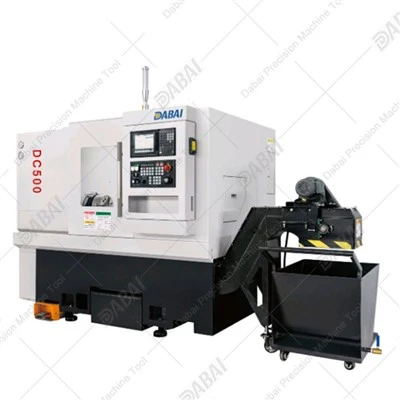
At the end of the day, a high-speed HMC isn’t just a faster mill—it’s a machine that lets you take on more jobs, finish them faster, and make better parts without all the headaches of older equipment. If you’re curious to see how a high-speed horizontal machining center could change your production, I’d be happy to walk you through a demo, answer your questions, or break down exactly how much you could save on your current workflow. Just reach out to chat more about your specific part needs and production goals.
Gantry Machining Center References:
Machining Technology Magazine. (2022). High-Speed Horizontal Machining Centers: Performance Metrics and Industrial Applications. SME.
American Machine Tool Association. (2023). 2023 Market Analysis of High-Speed Machining Equipment. AMTA.
Kalpakjian, S., & Schmid, S. R. (2021). Manufacturing Processes for Engineering Materials (7th ed.). Pearson.
Dabai Precision Machine Tool (Jiangsu) Co., Ltd.
As one of the most professional horizontal machining center manufacturers and suppliers in China, we’re featured by quality products and good price. Please rest assured to buy advanced horizontal machining center for sale here from our factory. We also accept customized orders.
Address: No. 66-1, Zhenhu North Road, Hudai Town, Binhu District, Wuxi City
E-mail: elaine@dabaicnc.com
WebSite: https://www.cnc-dabai.com/
